Birding in Ngorongoro: Best Time & Birding Safari Guide (2026)
Ngorongoro really stands out as one of Tanzania’s best birding destinations. You’ll find more than 500 bird species here in Ngorongoro Conservation Area, with some staying year-round and others arriving as seasonal migrants. The habitats for birding in Ngorongoro make it special, like the crater wetlands, alkaline Lake Magadi, Lerai acacia forest, volcanic highlands, and rim grasslands. So, that variety keeps birdwatching in Ngorongoro strong every month.
Birding or birdwatching, if you prefer, is simple. So, observe the birds in the Ngorongoro Crater, identify them, and note their behavior. Most people use binoculars, and many add a camera. In Ngorongoro Conservation Area, you have options. Also, stay comfortable in a 4×4 safari vehicle, or get closer on guided walking safaris to experience birding in Ngorongoro. Both work well.
Additionally, a good guide for your birdwatching Tanzania safari in Ngorongoro changes everything. They spot the hard-to-find birds. They explain calls, habits, and ecology. That turns a nice day into something memorable.
So if you love birds, Ngorongoro delivers. Diverse species. Stunning settings. Easy access. It’s hard to beat.
What Is Birding and Why Ngorongoro Is Exceptional
Birding or birdwatching is simply watching birds in their natural world. You spot them, identify them, and learn their ways. In Ngorongoro, that means tracking identification, behavior, breeding, feeding, and migration patterns. You can enjoy it in a few ways here. Guided walking safaris to track birds in Ngorongoro let you explore permitted parts of the crater on foot. Most people use 4×4 safari vehicles for comfort and wider coverage.
You can also stop at fixed points like the crater rim, Lake Magadi shores, or wetland edges for birdwatching safaris in Ngorongoro. Hiring a skilled birding guide makes a huge difference. They know where to look for rare, endemic, or hard-to-see species. Your Ngorongoro bird sightings jump way up with their help. Ngorongoro really shines for birding in Tanzania.
It packs high bird diversity into one compact area. Permanent water sources keep things reliable. Varied habitats from wetlands to forests to grasslands support and protect so many species year-round. That combination is tough to beat.
Why Choose Birding Safaris in Ngorongoro Conservation Area?
- Ngorongoro has many reliable habitats for the birds, like the Lake Magadi shorelines. So, these shorelines have algae that support the survival and reproduction of the lesser flamingos. Hence, no matter the season, tourists are guaranteed to go birdwatching in Ngorongoro near Lake Magadi at any time, unlike in other Tanzania National Parks.
- For example, the water levels in Lake Manyara National Park during the dry season become low, which makes birding in that park harder due to the absence of birds during that period.
- The terrain of the Ngorongoro, with the volcanic crater walls and the Verdant Lerai forest, makes bird photography in this wildlife conservation area extraordinary.
- Ngorongoro Conservation Area also surpasses other parks in birdwatching because of its endemic species. These unique birds in Ngorongoro, like the Hildebrandt’s starling, the Jackson’s Widowbird, and the Rufous-tailed Weaver, elevate your birding experiences since they are only found in this park.
Worst/Best Time for Birding in Ngorongoro Conservation Area
The best time for the birdwatching safaris in Ngorongoro is from early November to late April. This period aligns with the short and long rainy season, which favors the growth of vegetation, combined with the panoramas great for bird photography.
Also, this wet season attracts even migratory bird species to Ngorongoro, leading to a rich bird biodiversity. Hence, tourists can track down the specific bird species they want. Also, observe the rare endemic species ice the European Roller and Caspian Lapwing.
The worst time for birdwatching in the Ngorongoro Crater is from July to October. Since it’s a dry season period, the vegetation is usually thinner and migratory birds are less attracted to come to Ngorongoro. So, birds in Ngorongoro usually don’t breed during this time because of the dry weather.
Hence, observers are not guaranteed to witness bird activities. So, if one wants to track down and observe a specific bird, it might be hard due to a decrease in the birds’ population in Ngorongoro in those months.
Top Bird Species to Spot in Ngorongoro
1. Lesser flamingo.
The Ngorongoro Conservation Area is one of the places to visit in Tanzania with a high concentration of the lesser flamingos. Additionally, their main habitat in this region is Lake Magadi because of its algae on the banks, which is a source of food to these birds. The best time for travelers to specifically see these flamingo birds in Ngorongoro is from November to June.
So, this is because of the increase in algae due to higher volumes of water in Lake Magadi. Lastly, the amazing fact is that flamingoes are not born with the pink color but get it from the algae.
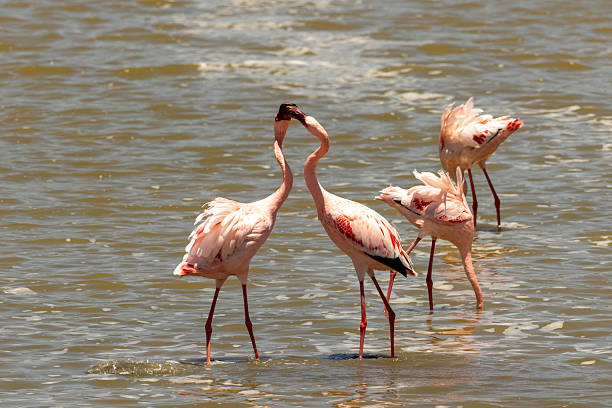
A spectacular flock of pink flamingos is gathered in Lake Magadi inside the Ngorongoro Crater, Tanzania, with two birds actively fighting in the water.
2. Secretary bird.
These are one of the largest birds in Ngorongoro with a height of approximately 1.4 meters. Additionally, the secretary birds of Ngorongoro are found in the open grasslands and are observed around the savannas of the crater rim. However, the best time to easily spot Secretary birds in the Ngorongoro Crater is from June to October.
So, during this dry season, these secretary birds are less covered. Lastly, these birds are hunters, and during lucky observations, travelers can see them capture their prey, such as lizards or even snakes.
3. European bee-eater.
This is one of the migrant birds of the Ngorongoro. Also, the European bee-eater is said to come from areas of Central Europe and Western Asia. Unlike other birds in the Ngorongoro Crater, the European bee-eater is multi colored. Also, they bring out the enchanting landscape of this conservation area during photographic captures.
Since European bee-eaters are migratory birds, the best time to see them is from November to mid-March. So, this period is when the green in Ngorongoro is flourishing because of the wet season.
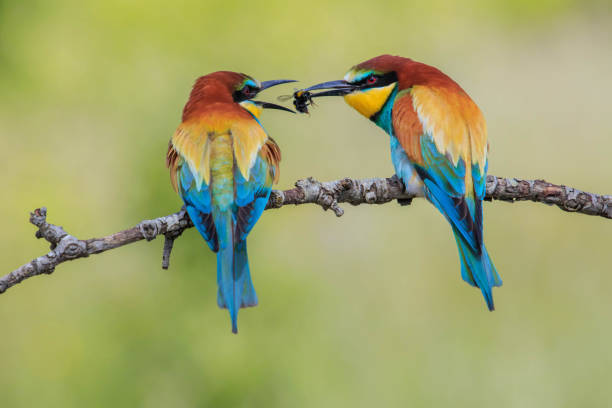
Two European bee eaters on a tree sharing an insect in Ngorongoro
4. Hamerkop.
This is one of the endemic species in Ngorongoro and the only one of the Scoriae family. The Hamerkop is skilled in nest making as it makes the larger ones among all the other birds using mud and even grass. These Hamerkop birds are usually sighted around wetlands like the Ngoitokitok springs and the edges of the Ngorongoro Crater in Tanzania.
In addition, it is one of the predator birds that feed on other animals, not forgetting its spiritual significance to some African cultures like the Zulu people.
5. Rufous–tailed weaver.
Even if its looks are not so appealing, this is one of the birds with enchanting voices. Sometimes, the Rufous-tailed weaver is referred to as a songbird. These bird species are spotted in the dry acacia woodland areas of Ngorongoro around the crater floor. Visit the Ngorongoro Crater between November to early March to observe the breeding period of these unique birds.
6. Kori bustard.
This is one of the heaviest birds in the Ngorongoro National Park. The Kori bustard male species might be the heaviest bird in the whole world. See these birds in the Hurter marshlands of the Ngorongoro Crater rim.
Their mating periods occur between late November and mid-March, and this is when they are most active. Kori bustards have a unique feeding pattern as they are omnivorous (feed on seeds and lizards), at the same time, they feed on the sap of the acacia trees.
7. The grey crowned crane.
These birds are normally found around areas like the Ngoitokitok springs and Mandusi swamp in the Ngorongoro Conservation Area. Also, it is sometimes referred to as a crested crane, and a national emblem for Uganda, which is a neighboring country of Tanzania. The crested cranes are the most entertaining bird species, famous for their enchanting dancing skills, and are also omnivores.
The bird species above are just a snippet of the popular birds found in the Crater. However, there are more than 500 bird species in this area, and birding in Ngorongoro is an activity where no penny is felt wasted for such a unique experience.
How to Prepare for Birding Safaris in Ngorongoro
- Booking a Birdwatching safari in Ngorongoro. Even though the Ngorongoro has a lot of popular bird habitats, some of the bird species are usually hidden. So, the best way to locate these Ngorongoro birds is through hiring an expert tour guide who is familiar with tracking down the different birds.
- Also, a Ngorongoro birding tour guide provides tourists with the knowledge and unique characteristics of this species. However, before you get one, check people’s reviews of the company the tour guide represents.
Essential Gear for Birding in Ngorongoro
Preparations for the birdwatching safari activities to do in Ngorongoro usually involve packing of technical gear. Some of the most essential gear for birding in Ngorongoro includes the below.
- The binoculars– The size of the birds in this park varies from tiny to the large ones. Additionally, some birds like the starling cannot only be seen with one’s bare eyes, so the binoculars make this easy by magnifying. An 8*42 pair of binoculars is what I would advise travelers to take.
- A camera – This is also one of the crucial pieces of equipment that travelers should not hold back during preparations for the birdwatching safaris in Ngorongoro. The ideal camera for photography in Ngorongoro is one with a telephoto lens of at least 400m because of its up-close great captures.
- Footwear and hydration pack – Accessing some birding habitats in Ngorongoro doesn’t involve safari vehicles. So, it is best for the travelers to hike to those areas for a more intimate touch on the grounds. Pack comfortable, waterproof hiking boots for the birdwatching safaris in this park. Lastly, the least time taken to hike the crater is about 30 minutes, hence it’s best for travelers to carry a water bottle to stay hydrated and healthy.
- Layered clothing – It is important for tourists getting to Ngorongoro for birdwatching safaris to pack lightweight clothes. Also, pack some warm clothes like a sweater, because the temperatures usually change according to the time of day. The clothes must be dull in color so that the tourists can camouflage within the surroundings and not scare away the birds.
How Many Bird Species Are in Ngorongoro?
The birds mentioned earlier are just a glimpse. Ngorongoro is home to over 500 bird species, spread across many habitats. You’ll find powerful raptors overhead, waterbirds along lakes and springs, and woodland and grassland species throughout the crater in Ngorongoro.
On top of that, seasonal migrants arrive each year, adding even more variety. Because of this mix of various birds, Ngorongoro National Park is among the top 10 best birding destinations in Africa. Are you a first-time birder or a seasoned ornithologist in Ngorongoro, Tanzania? Ngorongoro delivers a rich, immersive, and unforgettable birdwatching experience in Tanzania and Africa at large.